
Guide
Why Your Yard Holds Water in Southeastern Pennsylvania
The six drainage failures we actually find on Chester and Delaware County properties — what causes each one, how to tell them apart, and which fix belongs to which problem.
A yard that holds water is a symptom, not a diagnosis. The same puddle can come from a grading problem, a soil problem, a roof-water problem or a neighbouring-property problem, and the four have almost nothing in common except the puddle. Installing the wrong system for the actual cause is the most expensive mistake in residential drainage, because it does not fail immediately — it fails two seasons later, after the lawn has grown back over it.
This guide describes what we find on properties in Chester County, Delaware County and along the Main Line, and how to tell the causes apart before anyone starts digging.
The regional context: clay, till and a lot of roof
Southeastern Pennsylvania sits on the Piedmont, and much of the soil that matters for drainage is clay-rich subsoil under a thin topsoil layer. Clay does two things that drive nearly every drainage complaint in this region: it drains slowly, and it swells when wet and shrinks when dry.
Slow drainage means water that reaches the subsoil does not disappear downward at a useful rate — it moves laterally, along the top of the clay, until it finds somewhere lower. That is why water frequently surfaces well away from where it fell, and why a puddle in the middle of a lawn is often not a problem originating in the middle of that lawn.
The second factor is roof area. A typical single-family roof in these townships sheds thousands of gallons in a single significant rain event, and all of it is concentrated at a handful of downspout outlets. Managing that volume badly is the single most common cause of foundation water in the region.
Cause 1 — negative grade against the foundation
The ground within the first several feet of the house should fall away from it. On a great many properties it does not, either because it was never established correctly or because backfill around the foundation has settled over the years — which it always does, and most in the first decade after construction.
The tell is water standing against the foundation wall itself, or a damp band on the inside of the basement wall low down, worst after prolonged rain rather than after a heavy short burst. If the ground slopes toward the house, nothing installed further out in the yard will fix it.
The fix is regrading: rebuilding the fall away from the structure over the first several feet. It is frequently the cheapest permanent correction available and it is the one most often skipped in favour of something more visible.
Cause 2 — roof water discharged at the foundation
A downspout that ends in a splash block puts its entire share of the roof volume into the ground within a few feet of the foundation, repeatedly, at exactly the point where you least want it. On clay soil that water does not disperse; it saturates the backfill zone and sits there.
The tell is straightforward — localised wet ground, erosion or settlement at downspout corners, and basement dampness that correlates with which corner of the house is affected.
The fix is to carry that water away underground in solid pipe to a point where releasing it does no harm, which is usually further downslope and well clear of the structure. This is the highest-value-per-dollar work in residential drainage and it is why it is worth doing before anything more elaborate.
Cause 3 — a low spot with nowhere to go
Some yards have a genuine depression that collects water and has no outlet. On free-draining soil this resolves itself; on clay it becomes a pond that persists for days and eventually kills the turf.
The distinction that matters is whether there is anywhere lower to send the water. If there is, a catch basin and a collection line to that outfall solves it cleanly. If the property genuinely has no lower outfall — which happens on flat lots and in some developments — then the honest options are a dry well sized for the contributing area, a pump system, or regrading to relocate rather than eliminate the water. Anyone proposing a gravity system on a site with no fall should be asked where, specifically, the water is going.
Cause 4 — subsurface water moving laterally
This is the classic French drain condition and it is less common than the term's popularity suggests. Water moving along the top of the clay layer emerges partway down a slope, often as a persistently soft or springy area that never fully dries even in a dry spell.
The tell is ground that is wet without a rain event to explain it, frequently on a slope rather than in a hollow, and often with a distinct upper edge where the seepage begins.
A properly built French drain intercepts that flow: perforated pipe bedded in washed stone, wrapped so that fines cannot migrate in and silt it up, laid on a consistent fall to a daylight outfall. The two failure modes are no filter fabric and no real outfall — both produce a drain that works for a season or two and then stops.
Cause 5 — water arriving from a neighbouring property
On sloped ground in these townships, the water on your lawn is frequently not yours. Upslope roof discharge, driveway runoff or a neighbour's own drainage work redirected onto the property line will overwhelm a system sized for the lot alone.
It matters because it changes what has to be built. A system sized for your roof and your lawn will not handle your lot plus half of the one above it, and diagnosing this after installation is expensive. It also has a legal dimension in Pennsylvania that is worth understanding before it becomes a dispute — which is a conversation to have with the municipality, not a contractor.
Cause 6 — compaction and lost soil structure
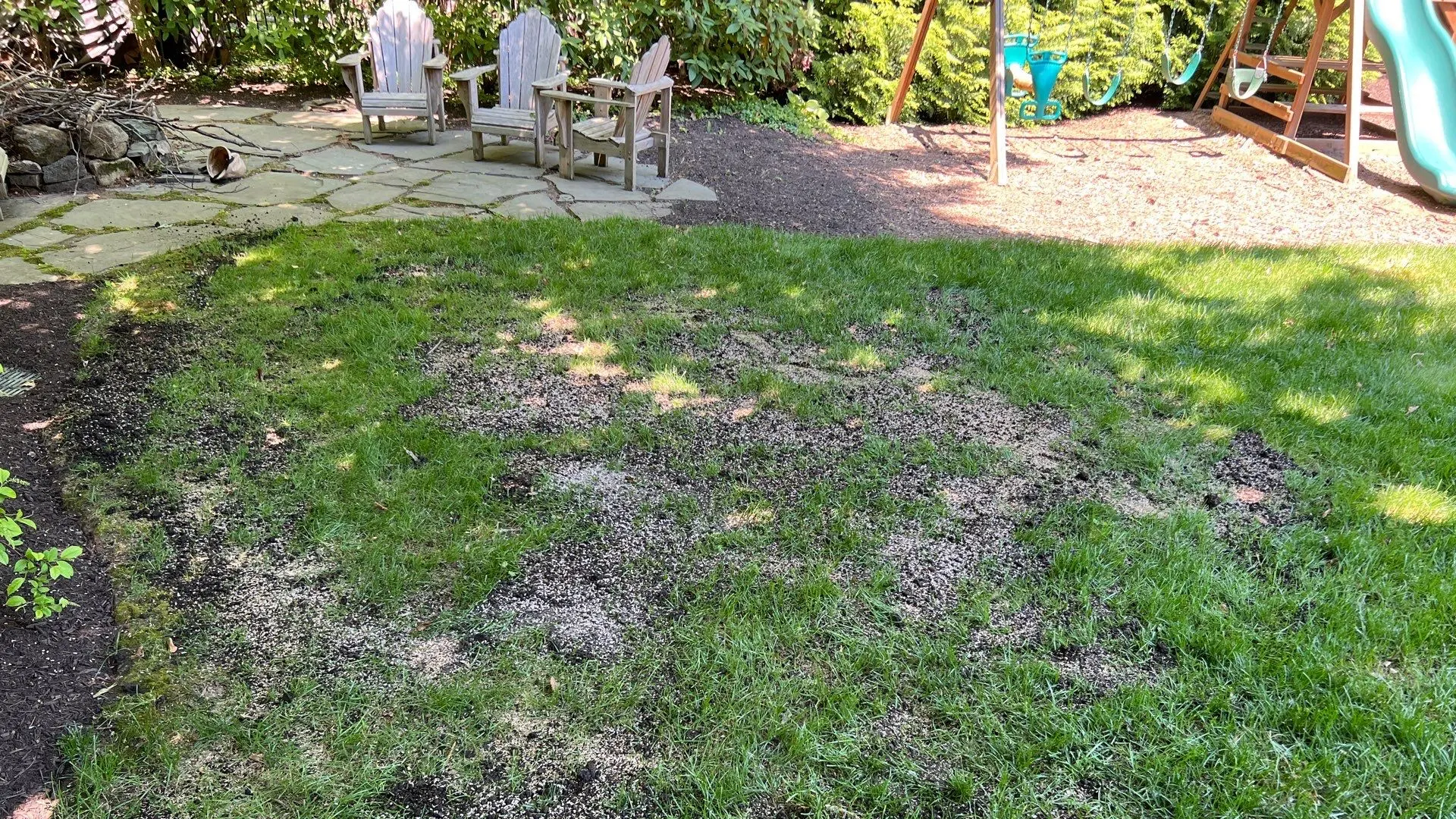
Newer construction frequently leaves subsoil compacted by equipment with a thin topsoil layer over it. The lawn looks finished; the ground beneath it accepts almost no water. The same effect develops over time in high-traffic areas and along vehicle routes.
The tell is water sitting on an otherwise level, correctly graded lawn with no obvious low point — the ground is simply not accepting it. This one is not a piping problem, and installing pipe will not fix it. It is addressed through soil decompaction and organic amendment, and it is worth identifying before spending money on a drainage system that has nothing to drain into.
How to work out which one you have
Watch the property during rain rather than after it. Where does water first appear, where does it travel, and where does it stop? That sequence identifies the cause far more reliably than the standing water that remains once it is over.
Then check the simple things in order: does the ground fall away from the house on all sides; where does every downspout actually discharge; is the wet area lower than its surroundings or on a slope; and does it stay wet in dry weather. Those four answers separate the six causes above almost completely.
Questions
Common questions
How long should water take to drain from a yard after rain?
Surface water should be gone within a few hours of the rain stopping. Ground that holds visible water for more than roughly a day after an ordinary rain event has a drainage problem rather than a heavy-rain problem, and ground that stays soft in dry weather points to a subsurface source rather than a surface one.
Will a French drain fix any wet yard?
No, and this is the most common misconception in residential drainage. A French drain intercepts water moving through the ground. If the actual cause is negative grade at the foundation, roof water discharged at the house, or compacted soil that will not accept water, a French drain addresses none of them. The diagnosis has to come first.
Is standing water in the yard actually a problem if the basement is dry?
It is a problem for the lawn and for the soil, and it is often an early indicator. Persistent saturation kills turf, encourages mosquitoes and progressively degrades soil structure. Where it sits near the structure it also loads the foundation backfill, which is the condition that tends to produce basement water later rather than immediately.
Find the cause before you pay for a fix.
On-site assessment. Free written estimate. No obligation.