
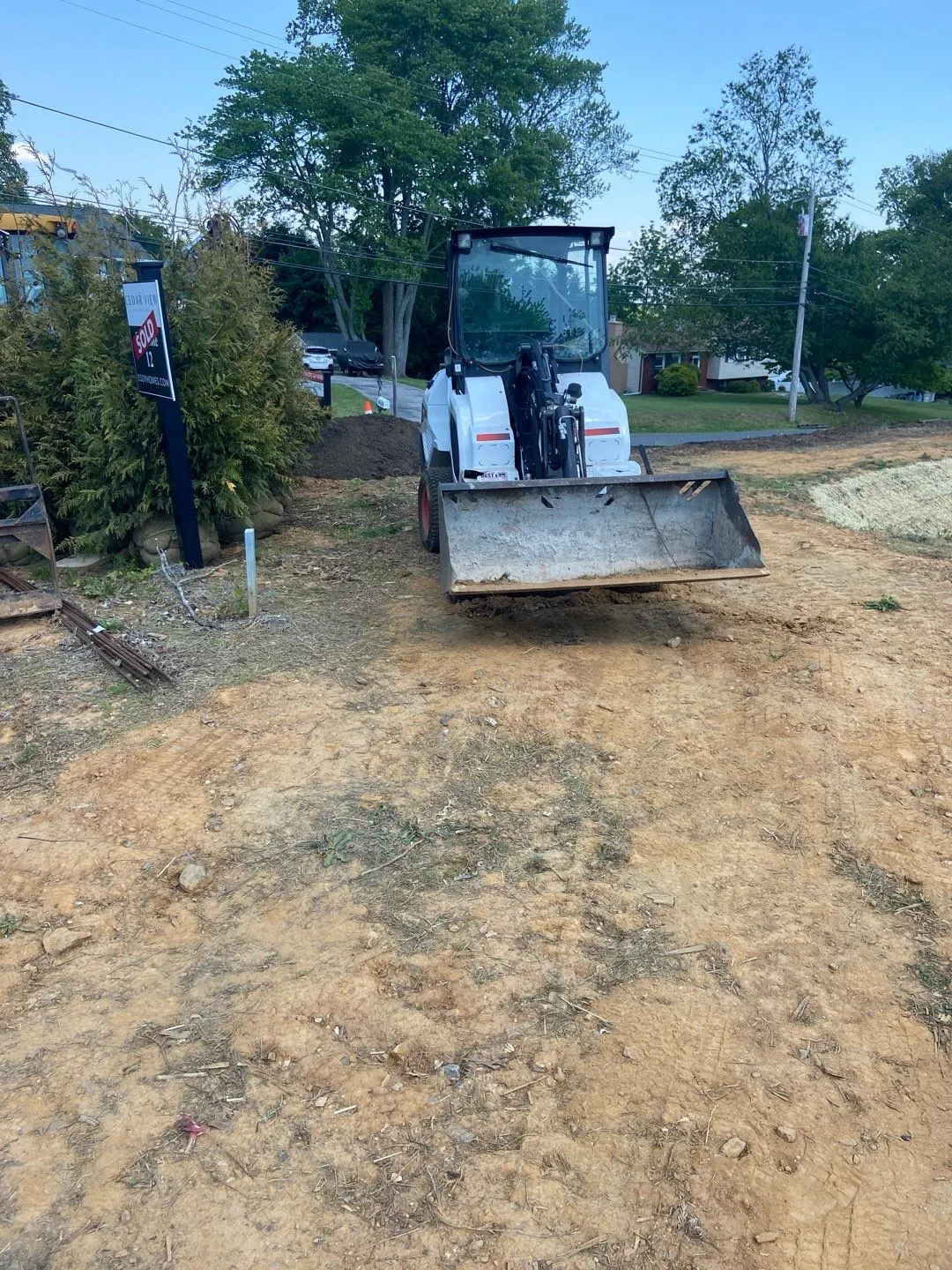
Drainage service
Downspout Drainage & Tie-Ins
Underground downspout extensions that carry roof water well away from the foundation instead of dumping it at the corner of the house.
Overview
Downspout Drainage & Tie-Ins in southeastern Pennsylvania
Roof water is the largest single volume most properties have to manage and the cheapest to get wrong. A significant rain event sheds a large volume off a typical roof, all of it concentrated at a handful of downspout outlets.
Released at the foundation on clay soil, that water saturates the backfill zone — the loosest, most permeable ground on the property, sitting directly against the structure. Moving it is generally the highest-value work available.
System components
Solid PVC pipe / Downspout adapters / Pop-up emitters / Catch basins
Why splash blocks do not work here
A splash block relies on the ground to absorb and disperse the discharge. On the clay-rich subsoil common across Chester and Delaware County the ground does not do that at any useful rate. The water pools, then follows the path of least resistance — which is the disturbed backfill against the foundation wall.
What makes a carrier line work or fail
Solid pipe, not perforated — a carrier must not leak along its length, or it recreates the problem underground where it cannot be seen. Consistent fall, because a line with a sag holds water and a line holding water in December freezes and backs up. Rigid smooth-wall pipe rather than corrugated flexible tubing, whose interior traps sediment and which is very easy to lay with unintended dips.
And sized for peak flow rather than average. A line that cannot pass a summer downpour backs up at the downspout and overflows at the foundation — failing precisely during the events that matter.
Questions
Downspout Drainage & Tie-Ins questions
Can downspouts be tied into a footing drain?
No. A footing drain relieves groundwater pressure at the foundation; feeding roof volume into it works against that purpose and can push water toward the structure during exactly the storms when it is most needed. They should stay separate systems with separate outfalls.
How far should a downspout discharge from the house?
Far enough that water cannot track back through the foundation backfill, and to a point genuinely lower than the inlet. On clay with limited fall that is further than most homeowners expect, which is why the carrier line is usually the larger part of the work.
What if there is nowhere lower to discharge to?
A dry well sized for the contributing roof area, or a pumped discharge to a suitable release point. Both are legitimate and both need sizing to the actual area feeding them.
By town
Downspout Drainage by town
Each page covers how this system behaves on that town's ground.
- Downspout Drainage in Bryn Mawr, PA
- Downspout Drainage in Downingtown, PA
- Downspout Drainage in Exton, PA
- Downspout Drainage in Havertown, PA
- Downspout Drainage in Malvern, PA
- Downspout Drainage in Media, PA
- Downspout Drainage in Newtown Square, PA
- Downspout Drainage in Springfield, PA
- Downspout Drainage in Villanova, PA
- Downspout Drainage in Wayne, PA
- Downspout Drainage in West Chester, PA
Need downspout drainage?
On-site assessment. Free written estimate. No obligation.